What aura treatment actually is
An aura crystal starts life as an ordinary natural stone. It goes into a vacuum chamber, a metal is heated until it vaporises, and that vapour settles onto the surface of the stone and bonds to it. The layer left behind is measured in nanometres: far thinner than a human hair, thin enough that you are still touching the stone underneath when you pick it up.
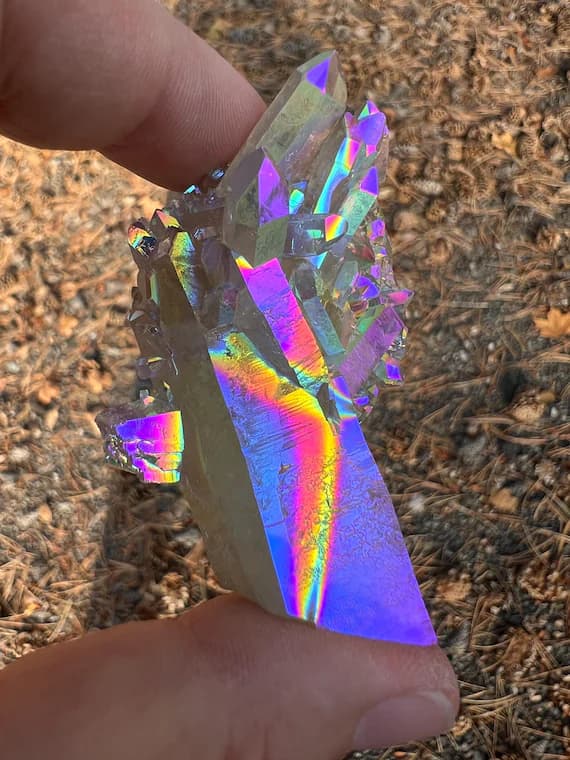
The colour is not paint and it is not dye. It comes from the film being so thin that light reflecting off its top surface meets light reflecting off its bottom surface, and the two interfere with each other. Some wavelengths cancel out and some reinforce, and which ones depends on the exact thickness of the film and the angle you are looking from. That is why the colour moves as you turn the piece, and it is the same physics that makes a soap bubble or a puddle with petrol in it shimmer.
It is also why photographs never quite do it. A photo fixes one angle, and the whole point is what happens between angles.
The finishes I sell
Different metals, and different thicknesses of the same metal, land on different parts of the spectrum. These are the ones I carry, by the names I use for them.
Rainbow aura
Made with titanium
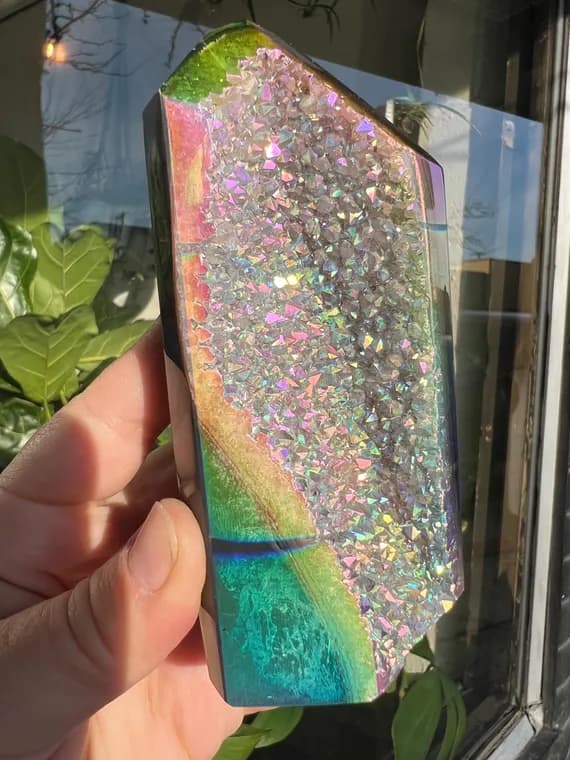
Rainbow aura is the loudest of the finishes and the one most people picture. A whisper-thin layer of titanium goes onto the stone in a vacuum chamber, and the film is so thin that light bounces off both its top and bottom surfaces at once. The two reflections interfere with each other, and that interference is the colour. It is the same physics as a soap bubble or an oil slick, which is why the colour moves as you move.
Shop rainbowAngel aura
Made with platinum and silver
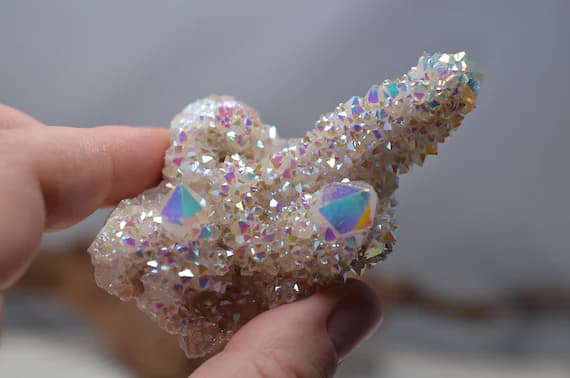
Angel aura is the gentle one. Platinum with a little silver leaves a pale, milky iridescence, closer to the inside of a shell than to a rainbow. It suits clusters with a lot of small terminations, where the light catches across dozens of tiny faces at once.
Shop angelOpal aura
Made with platinum
Opal aura sits between angel and aqua: a platinum film tuned to a pale blue-white, with a warmth to it in low light. On clear quartz it looks like frost that has not decided to melt.
Shop opalAqua aura
Made with gold
Aqua aura is the surprise: it is made with gold, but at that film thickness the interference favours blue, so you get a deep sea-glass colour with gold flashing at the edges. It is one of the oldest aura finishes and still one of the most convincing.
Shop aquaMoonbeam aura
Made with a silver and titanium blend
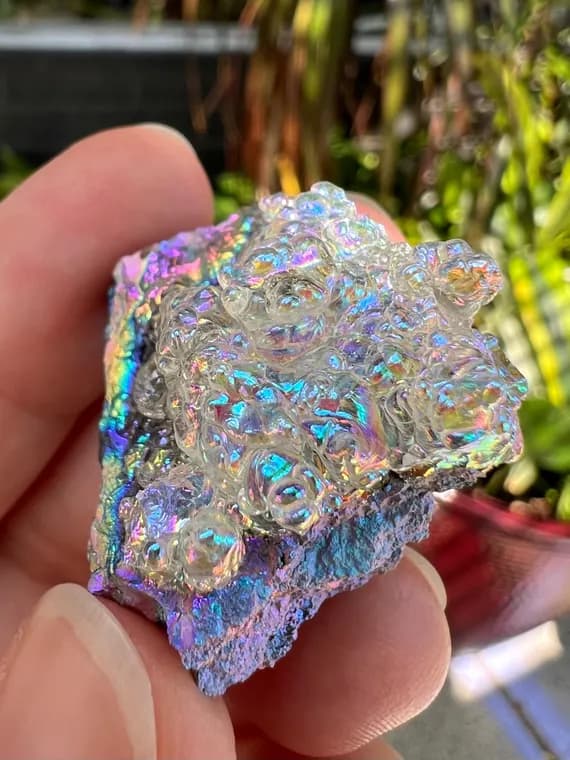
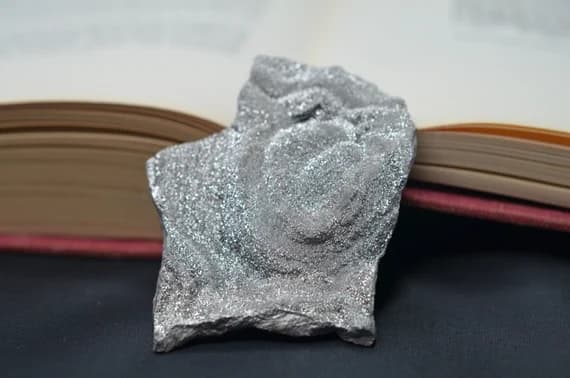
Moonbeam is Cosmic's name for the cool silvery finish that holds its colour in low light. It is the one to pick if a full rainbow feels like too much, and it looks especially good on prehnite and on anything with a botryoidal, mounded surface.
Shop moonbeamFire aura
Made with titanium, run warm
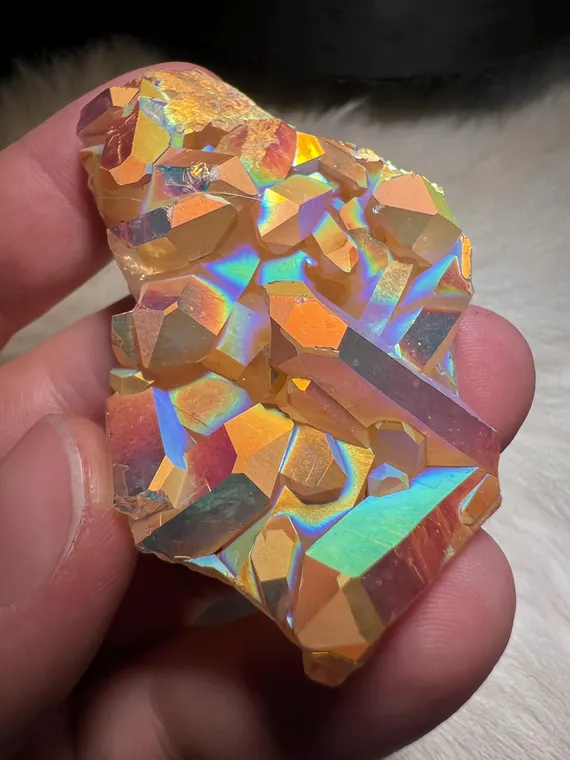
Fire aura keeps to the warm end of the spectrum: copper, orange, gold, and hot magenta, with very little blue. On fluorite it is dramatic, because the cubes catch the colour on every face at a slightly different angle.
Shop fireSilver aura
Made with silver
Silver aura is the most restrained finish in the shop. It reads as a true metallic coat rather than an iridescence, and it suits pieces where the shape is the interesting part and colour would only get in the way.
Shop silverTitanium aura
Made with titanium
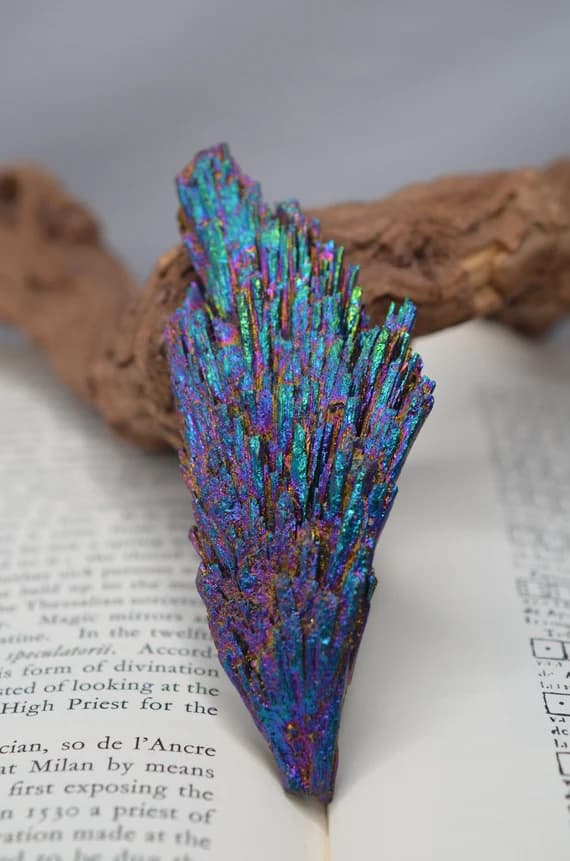
Titanium aura goes darker and richer than rainbow, into peacock blues, violets, and greens. It is the finish that photographs least well and looks best in person, which is a shame for a website and a delight in the shop.
Shop titaniumHow to tell treated from natural
The giveaway is usually the colour itself. Natural stones rarely go metallic, and they almost never shift through a full rainbow as you turn them. If a quartz point looks like an oil slick, it has been treated.
Look at the coverage too. A treatment coats the outside, so it follows every face and every crevice evenly and stops wherever the stone was resting during the process, sometimes leaving an untreated patch on the base. Natural colour grows through a stone rather than sitting on it, so a broken edge on a natural amethyst is still purple, while a chipped aura piece shows plain stone underneath.
You should not have to work this out from a photo, though. Everything on this site is labelled either way, on the card and on the piece’s own page.
Does it last?
Yes, with ordinary care. The metal is bonded to the surface rather than sitting on it like a coat of varnish, so it does not peel or flake, and it will not rub off in your hand.
What can damage it is abrasion and harsh chemicals. Scrubbing a treated piece, running it through an ultrasonic cleaner, or leaving it in salt will wear through a layer that thin. Long stretches in direct sunlight are not ideal either, for the aura or for the stone.
How to clean them
Keep it out of direct sun for long stretches and away from harsh cleaners. The finish is bonded to the surface, but it is thin.
Dust it with a dry, soft cloth. No salt, no ultrasonic cleaners, and no scrubbing.
No salt, no ultrasonic cleaners, no chemical cleaners, and nothing abrasive. A dry, soft cloth is genuinely all it needs.
What it changes, and what it does not
It changes the surface and it changes how the light behaves. It does not change what the stone is. A rainbow aura amethyst is still amethyst: same mineral, same hardness, same everything, wearing a few nanometres of titanium.
People often ask whether treatment changes what a stone means to them. That is genuinely a personal question and I am not going to answer it for you. What I will say is that plenty of collectors keep both, for different reasons, and that nobody has ever picked up a rainbow aura cluster and been bored by it.
Where the treatment happens
I hand-pick the natural stones myself and send them to a specialist lab in the United States for treatment, then keep the ones that come back showing off. Every treated piece on this site says so, on the card and on its own page.
Browse the aura crystals